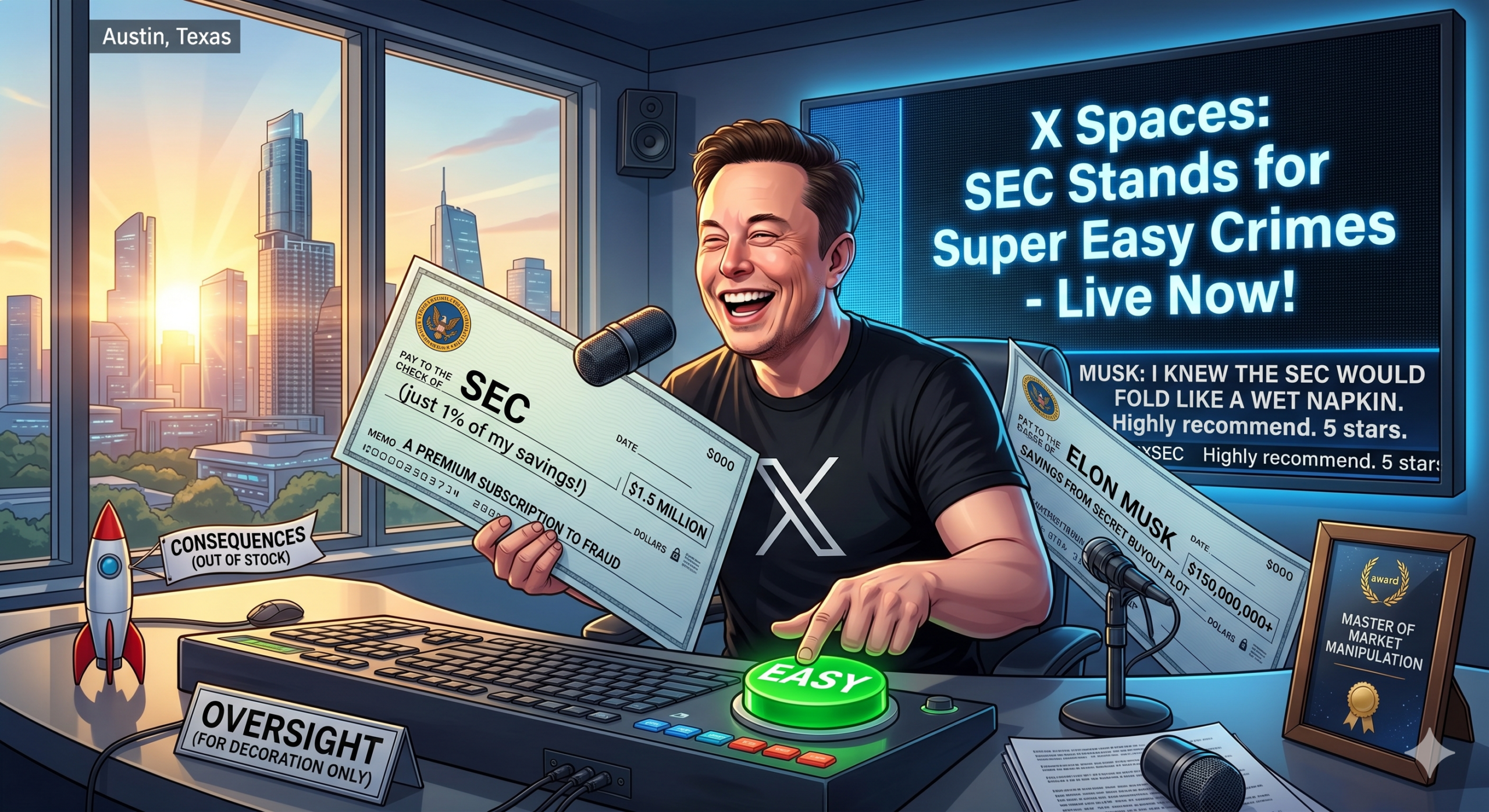
AUSTIN, TX — Following Monday’s announcement that Elon Musk and the Securities and Exchange Commission have officially settled their long-running legal dispute over his 2022 acquisition of Twitter, the billionaire didn’t issue a solemn apology. Instead, he essentially left a glowing, five-star review for white-collar crime.
The May 4, 2026 settlement officially closes the books on the SEC’s investigation into Musk’s shadowy disclosure tactics. For those keeping track at home, the terms are staggering: in exchange for allegedly misleading investors, saving himself an estimated $150 million by quietly under-buying stock, and blatantly flouting federal disclosure timelines regarding his 9.2% stake, the world’s richest man has agreed to a devastating, earth-shattering penalty of… $1.5 million.
“To be completely honest, I thought they’d at least ask for ten million, maybe make me write a public apology using a quill,” Musk reportedly laughed during an impromptu early-morning X Spaces broadcast titled SEC Stands for Super Easy Crimes. “But one-and-a-half million? That’s not a penalty. That’s just a convenience fee for ignoring federal law.”
The controversy dates back to early 2022, when Musk began quietly gobbling up Twitter stock. By March 14, he had crossed the 5% threshold that legally required him to notify the SEC and the public. Instead, Musk waited 21 days, filing late on April 4. To add insult to injury, he initially filed a Schedule 13G—a form meant strictly for passive investors who have no intention of influencing the company—while simultaneously orchestrating a $44 billion hostile takeover to take the company private.
According to Musk, the strategy wasn’t a happy accident; it was a calculated bet on the SEC’s chronic lack of backbone.
“I literally told the market I was just a chill, passive shareholder while actively plotting to fire the entire C-suite and rename the platform after a letter in the alphabet. It was so incredibly easy to commit fraud and mislead the investors,” Musk boasted to his millions of listeners. “People ask me, ‘Elon, weren’t you worried about the consequences?’ And the answer is absolutely not. I knew the SEC would fold like a wet napkin. They’re like a substitute teacher who politely asks the classroom to please stop throwing chairs.”
By keeping his buying spree a secret from the market for nearly a month, Musk suppressed the share price and pocketed roughly $150 million in savings. Now, four years later, he is paying just 1% of those savings back to the government to make the problem go away. Financial analysts have noted that the settlement provides zero deterrence for future market manipulation, a point Musk enthusiastically agreed with.
“It’s a massive return on investment,” Musk elaborated. “If you told a bank robber he could steal $150 million, and the only catch was that four years later he’d have to give a measly $1.5 million to the government, there wouldn’t be a single bank left in America. Honestly, I’m offended they didn’t offer me a punch card. Commit ten securities violations, get your eleventh free.”
The SEC’s 4-1 vote to accept the settlement has left many critics crying foul, but for Musk, the case is a resounding victory for his personal philosophy of consequence-free billionaire antics. He noted that the initial demand from the SEC had been the full $150 million plus penalties, but by simply dragging the case out and complaining about “harassment,” the agency panicked and dropped their price.
“I delayed that 13D filing because I wanted to test the physics of the regulatory universe, and it turns out, there’s absolutely no gravity,” Musk declared, wrapping up his broadcast. “You can just buy a social media network on layaway, completely manipulate the market, tell regulators to kick rocks, and four years later they ask you to pay a fine that is mathematically equivalent to the coins I find in the couch cushions of my private jet. Highly recommend. Five stars.”
At press time, the SEC declined to comment on Musk’s statements, reportedly because they were busy drafting a sternly worded internal memo that no one will read.